
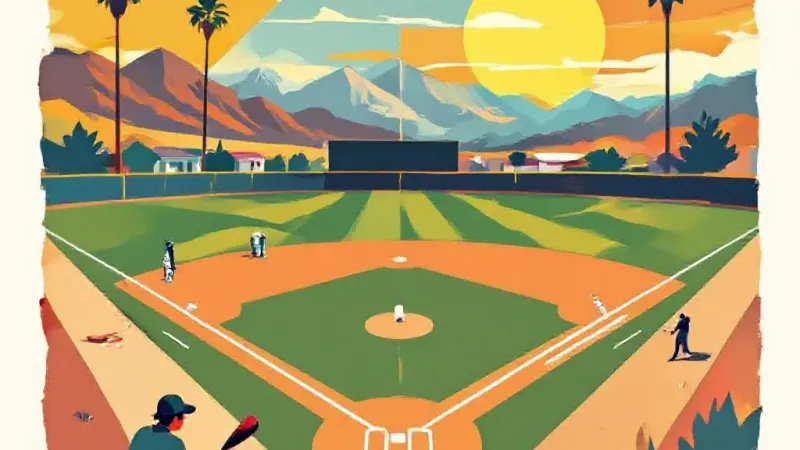
Last weekend, hundreds gathered at Manzanar, a former Japanese American concentration camp in California’s eastern Sierra mountains, to witness a double-header on a painstakingly restored historic baseball diamond. The event, spearheaded by 71-year-old Los Angeles performance artist Dan Kwong, served as both a living history exercise and a stark message about contemporary challenges.
Kwong, whose mother and aunt were confined at Manzanar, initially envisioned the project as a way to convey the trauma experienced by 120,000 men, women, and children incarcerated after the Japanese attack on Pearl Harbor. He understood that baseball was not only a distraction for internees but also a quiet expression of their loyalty to the United States. He aimed to cast the game as an act of resistance and educate new generations on the damage caused when governments infringe upon constitutional rights.
However, Kwong noted that recent events, including a new wave of detention camps and mass arrests, have made the treatment of Japanese Americans in the 1940s relevant in a shocking and undeniable way. He stated that the lessons of Manzanar are no longer just a cautionary tale but a "call to arms."
Players from California’s Japanese American baseball league donned 1940s-era uniforms, gloves, and helmets. They played on the grassless dirt field, navigating the unusual way the ball bounced and skittered across the sagebrush beyond the outfield. Kwong himself took the field, playing for his long-time team, the Li’l Tokio Giants, and later in an all-star game. The crowd, many using Japanese-style paper parasols for sun protection, cheered his appearances.
Between games, Kwong delivered a speech connecting a modern political movement to what he described as a “premise of domination and supremacy” that historically rendered different immigrant groups and citizens of color vulnerable to scapegoating. He emphasized that the past becomes unfrozen at Manzanar, allowing attendees to confront "the contradictions embedded in America’s legacy."
Ann Burroughs, chief executive of the Japanese American National Museum in Los Angeles, echoed these sentiments, stating that "The lessons of Manzanar have never been more urgent." She highlighted that the racism, xenophobia, and cruelty that enabled Manzanar are again evident, with laws previously used to discriminate being utilized once more.
Symbolic moments punctuated the day. Actors in 1940s clothing appeared carrying suitcases, representing the arrival of families, mostly from Los Angeles, in the spring of 1942. Celebrated Japanese American singer Nobuko Miyamoto sang of the despair experienced by those unjustly held behind bars, eliciting audible sobs from spectators, many of whom grew up hearing stories of the camp from their families.
Among the attendees were at least five men aged 90 or older who had been at Manzanar, including Masayoshi Morioka, who arrived as a nine-year-old. Morioka’s grandson, Mason, played in the all-star game, prompting Morioka to vow to attend "for the last time in my lifetime."
Kwong’s project was years in the making. The field was initially neglected and overgrown, and the National Park Service, which maintains Manzanar as a historical monument, had reservations about an outsider overseeing the restoration and bringing in large crowds. Kwong, however, persisted, raising funds and gaining park ranger support. For three years, he frequently made the 225-mile drive from Los Angeles, sometimes with volunteers, sometimes alone, to clear foliage, smooth terrain, excavate outfield posts, erect a fence and bleachers, and build an announcer’s booth.
Challenges mounted along the way. Kwong first staged a game in 2024, but without public access. A federal government shutdown the following year disrupted plans for a grander event. This spring, a powerful windstorm destroyed the fence, necessitating its rebuilding. The park service also imposed restrictions, requiring offsite parking and a shuttle bus for spectators. An announcer’s booth, half-built, was deemed not to meet government safety standards, leading to announcers using a simple table. Kwong also mentioned being advised to be cautious about his statements as a volunteer at a government site, a reflection of official nervousness potentially tied to government workforce cuts. The announcers at the event read a lengthy legal disclaimer and warned players to pause games when cars passed the field every few minutes.
Manzanar was the first of ten camps established for the Japanese American population of the western United States, representing the largest mass incarceration in U.S. history, according to the Manzanar Baseball Project website. The site, once thriving farmland with apple and pear trees, became arid after the city of Los Angeles acquired vast tracts of land in the Owens Valley and drained water for its own development in the early 20th century. Before its requisition by the government, the area was known as a filming location for westerns.
Baseball and softball were deeply ingrained in Japanese American life in California, continuing within the camps. Some pre-war teams remained intact and played each other, while new teams like the ManzaKnights and, among women, the Dusty Chicks, emerged. Leagues became so strong that authorities permitted teams to travel between concentration camps for games.